Before the main content: I am creating an R Community on Google Groups. You can join the group using this form.
Nearly a year ago, I fell on snow while walking to class. I landed on my back with a backpack on and hit my head on the ice. The fall led to a hospital stay, extensive paperwork, and a large medical bill. An emergency MRI found a tear in one of my carotid arteries. I take daily aspirin to reduce the risk of stroke and expect to continue for at least another six months.
During the hospitalization, a doctor called the injury a “chiropractor’s neck”, a term that provides a description of the kind of artery injury that doctors see after forceful neck movement. But if falling on ice can cause the same injury as a neck adjustment then the question is: are neck manipulations safe?
This is a personal account, not a diagnosis or medical advice. I am summarising what scientific evidence shows about the risk of deliberately applying rapid force to the neck.
What happened
The fall was followed by the following symptoms: headache, dizziness, and buzzing in my ears. The MRI showed a carotid artery dissection: a tear in the artery wall. A dissection can obstruct blood flow or allow a clot to form, and that clot can cause a stroke. Fortunately, I did not have a stroke and the injury was found because I returned two more times on the same day to the emergency department after I was dismissed first when I reported an abnormal headache and ears buzzing.
What the evidence says
The American Heart Association and American Stroke Association report an association between cervical manipulative therapy and cervical artery dissection. They also state that the available evidence does not establish causation. Both statements need to be kept: the signal is real enough to matter, but the current studies are insufficient and we require more evidence to determine a causal link.
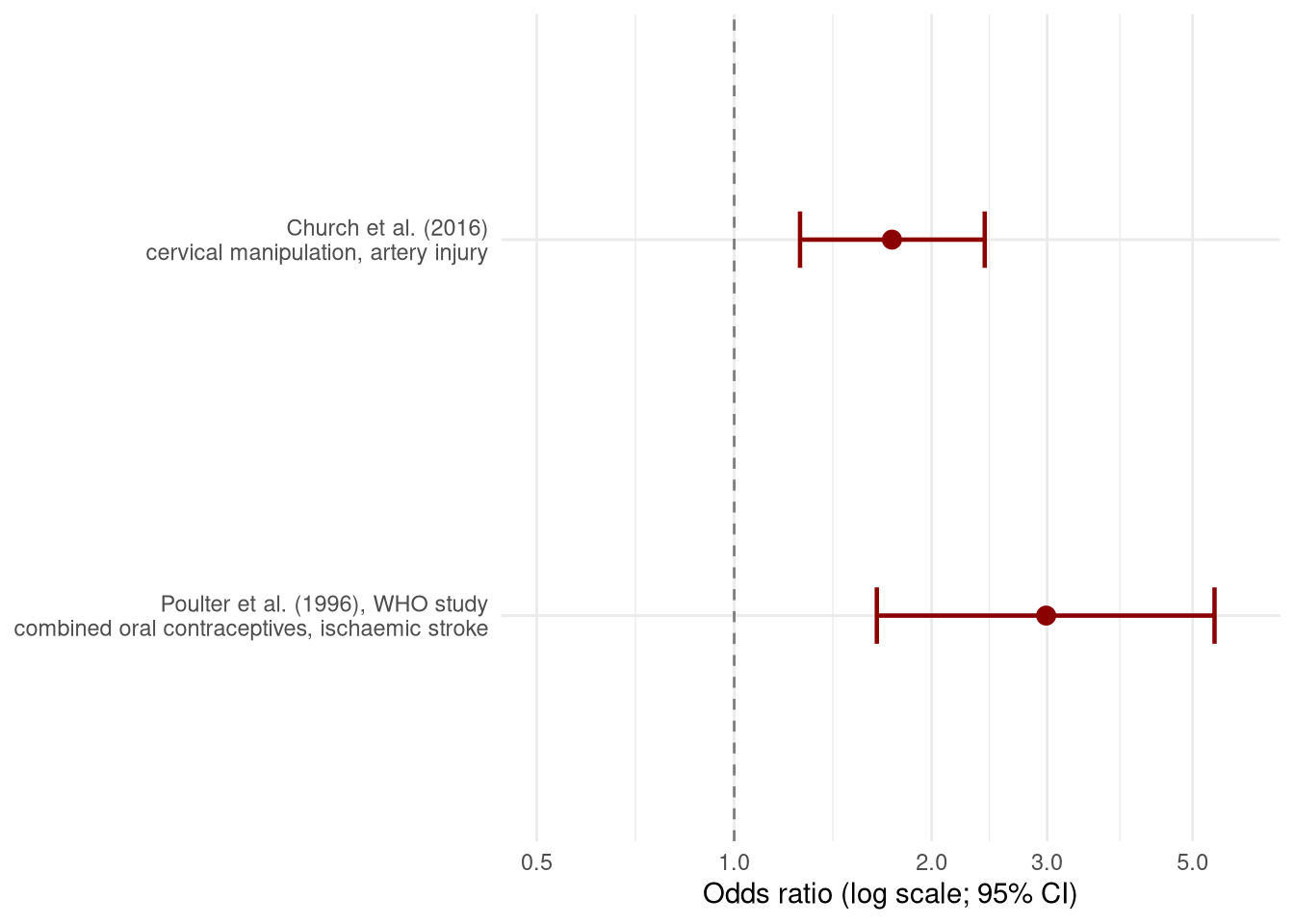
A systematic review and meta-analysis by Church et al. (2016) reported an odds ratio of 1.74 for cervical artery injury after chiropractic care, with a 95% confidence interval from 1.26 to 2.41. The authors rated the certainty of the evidence as very low. This is not a precise estimate of the risk caused by a neck adjustment. “Very low certainty” does not mean “no risk”; it means that the number should not be treated as settled.
A population-based case-crossover study by Cassidy et al. (2017). found no excess risk of carotid stroke after chiropractic visits compared with primary-care visits. The authors argued that the patients’ underlying neck pain could explain why both types of visit were followed by a diagnosis. This is an important alternative explanation, but it is not evidence that a high-velocity neck manipulation is harmless. A comparison with another healthcare visit can identify confounding without establishing that the intervention itself is safe.
The AHA/ASA states that “Current biomechanical evidence is insufficient to establish the claim that cervical manipulative therapy (CMT) causes cervical artery dissections (CDs), clinical reports suggest that mechanical forces play a role in a considerable number of CDs and most population controlled studies have found an association between CMT and VAD stroke in young patients.” The full details behind this are covered in Biller et al. (2014).
Putting the odds in context
An odds ratio of 1.74 sounds small next to headline numbers such as “1 in a million”. It is worth asking: 1.74 times what? An odds ratio only tells you the relative change; to feel the actual size of the risk you need a baseline, and here we have two independent baselines from the same population-based project (the Rochester Epidemiology Project, Olmsted County, Minnesota).
Lee et al. (2006) found an average annual incidence of cervical artery dissection of 2.6 per 100,000 people over 1987-2003. Using the same surveillance system but more sensitive imaging, Yaghi et al. (2023) found an overall incidence of 4.69 per 100,000 person-years over 2002-2020, rising to 8.93 per 100,000 person-years in 2017-2020. So even before anyone touches a patient’s neck, the background rate of this “rare” injury is not negligible, and it has been climbing as detection has improved.
If cervical manipulation really multiplies the baseline odds of cervical artery dissection by around 1.74, applying that factor to the 2017-2020 Olmsted County rate of 8.93 per 100,000 would put the exposed rate near 15-16 per 100,000 person-years, and this is above the US motor-vehicle death rate. This is an illustrative calculation, not a validated risk estimate: odds ratios from case-control designs do not translate cleanly into incidence rates, the populations are different, and the AHA/ASA is explicit that causation is unproven. But it shows why “very low certainty” is not the same as “too small to matter”.
An, independent comparison helps calibrate how seriously clinicians already treat odds ratios of this size. The WHO Collaborative Study on Cardiovascular Disease and Steroid Hormone Contraception, a large international case-control study (Poulter et al., 1996), found that combined oral contraceptives were associated with an odds ratio of about 2.99 (95% CI 1.65-5.40) for ischaemic stroke in women of reproductive age. That is a widely prescribed medication, and its stroke risk is disclosed on the label and allegedly discussed at every prescription. The chiropractic odds ratio of 1.74 is smaller, but it is the same kind of number, describing the same kind of outcome, and it deserves the same kind of disclosure.
library(ggplot2)

comparison <- data.frame(
  study = c(
    "Church et al. (2016)\ncervical manipulation, artery injury",
    "Poulter et al. (1996), WHO study\ncombined oral contraceptives, ischaemic stroke"
  ),
  estimate = c(1.74, 2.99),
  lower = c(1.26, 1.65),
  upper = c(2.41, 5.40)
)

comparison$study <- factor(comparison$study, levels = rev(comparison$study))

ggplot(comparison, aes(y = study, x = estimate)) +
  geom_vline(xintercept = 1, linetype = 2, colour = "grey50") +
  geom_errorbar(
    aes(xmin = lower, xmax = upper),
    width = 0.15,
    linewidth = 0.8,
    colour = "#8B0000"
  ) +
  geom_point(size = 3, colour = "#8B0000") +
  scale_x_log10(
    breaks = c(0.5, 1, 2, 3, 5),
    limits = c(0.5, 6)
  ) +
  labs(
    x = "Odds ratio (log scale; 95% CI)",
    y = NULL
  ) +
  theme_minimal(base_size = 11)
Conclusion
The evidence does not prove that every neck manipulation causes an artery dissection. It does not need to prove that in order to answer the safety question. A procedure is not safe merely because its worst complications are rare, its observational evidence is difficult, or its patients may already have the condition that later gets diagnosed. Here, the possible outcome is stroke, and the current research cannot reliably identify who is vulnerable or quantify the causal risk.
So my conclusion is straightforward: forceful cervical manipulation should not be presented as a safe routine treatment, and I consider it a genuinely risky thing to do to your neck. “Not proven to cause harm” is not the same as “safe”, especially when the potential harm is catastrophic, the background rate of the injury is already in the same range as a car crash death, and the benefit does not justify pretending the uncertainty away. People may still choose it, but informed consent should say plainly that serious vascular injury is a possible risk—not hide behind the fact that the exact probability is unknown.
If you have new or unusual neck pain or headache, especially after an impact (e.g., falling from a bike, etc.), do not get further manipulation while trying to figure it out. Seek urgent medical assessment. Neck pain or headache accompanied by dizziness, weakness, speech trouble, vision changes, or severe imbalance is an emergency.
This particular incident, and returning to ER after a “you are probably fine” now feels like “extremely lucky” and “extremely unlucky” at the same time and feels like hospitals should examine their patients better. Trust your gut.
Sources
- Biller et al. (2014), American Heart Association/American Stroke Association scientific statement on cervical arterial dissections.
- Church et al. (2016), systematic review and meta-analysis, PMCID: PMC4794386.
- Cassidy et al. (2017), population-based case-crossover study, PMID: 27884458.
- Lee et al. (2006), incidence and outcome of cervical artery dissection, Neurology, PMID: 17130413.
- Yaghi et al. (2023), epidemiology of spontaneous cervical artery dissection, Stroke.
- NHTSA (2023), Traffic Safety Facts / FARS Quick Facts.
- Poulter et al. (1996), WHO Collaborative Study on Cardiovascular Disease and Steroid Hormone Contraception, ischaemic stroke and combined oral contraceptives, The Lancet.